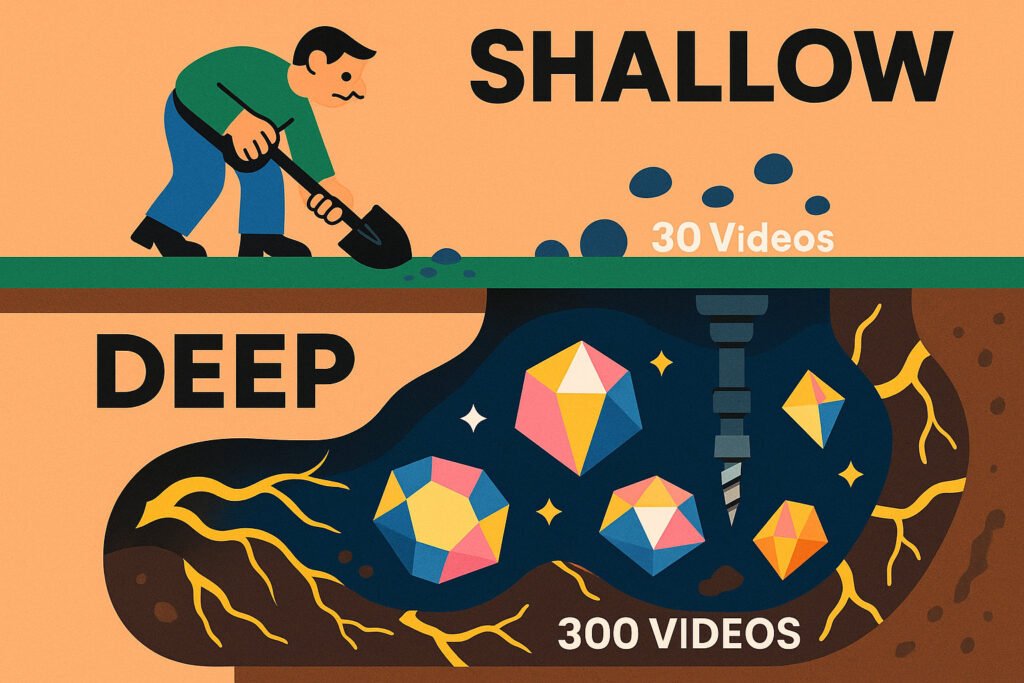
Why Analyzing the Last 300 Videos Reveals Secrets That “Recency” Hides (The Law of Large Numbers)
Are you suffering from “Recency Bias”?
Most free analytics tools on the market have a hidden limitation: they only scrape the first page of a channel’s results. Usually, this means you are only seeing the last 30 videos.
For a daily vlogger, 30 videos is just one month of data. For a weekly uploader, it’s six months. While this gives you a snapshot of current performance, it is often statistically misleading. You are seeing the “Weather” (short-term fluctuations), not the “Climate” (long-term patterns).
To build a resilient channel strategy, you need meaningful sample sizes. In this deep dive, we explore the statistical advantage of Channel Profiler Pro’s 300-Video Analysis and how digging deeper into history unlocks the “Evergreen” content strategy.
Part 1: The Law of Large Numbers
In statistics, the “Law of Large Numbers” states that as a sample size grows, its mean gets closer to the average of the whole population. In simple terms: Small data lies; big data tells the truth.
The “Lucky Hit” Trap (n=30)
Imagine you analyze a competitor’s last 30 videos. You see they got 100,000 views on a video about “AI Art.” You think: “Aha! AI Art is the trend. I must copy this.”
But what if that was just a fluke? What if they covered “AI Art” five times in the past, and the other four times it flopped? With a shallow analysis (30 videos), you miss the failures. You only see the survivor.
The Strategic Truth (n=300)
When you use Channel Profiler Pro to fetch 300 videos, you see the full picture. You might discover that out of 10 attempts at “AI Art,” only one worked. Meanwhile, their “Photoshop Tutorials” have performed consistently well 50 times in a row.
Key Takeaway: Don’t build your business strategy on a coin flip. Use 300 videos to validate that a topic is a consistent winner, not a lucky strike.
Part 2: Uncovering “Evergreen” Income
YouTube views come in two flavors:
- Viral Views (Velocity): High spikes, fast decay. (e.g., “News”, “Drama”, “Trends”).
- Evergreen Views (Search): Slow burn, lasts for years. (e.g., “How to fix a leaky faucet”).
Shallow tools only show you the Viral Views because they focus on what was uploaded recently. But the most profitable channels are often built on Evergreen content uploaded 2 years ago.
By scanning the last 300 uploads, you can identify the “Old Guard”—videos that are 12+ months old but still generating data signals. These are the topics you want to target for passive income, not just quick clicks.
Part 3: Spotting Seasonal Cycles
Content is cyclical. What works in December often fails in July. If you only look at a competitor’s last 30 videos during the summer, you will miss their entire Q4 strategy.
The 300-Video Time Machine
Fetching 300 videos allows you to travel back in time. For a channel posting weekly, 300 videos is nearly 6 years of history. For a daily poster, it’s nearly a year.
This allows you to answer critical questions:
- “What did this tech channel review last September?” (Predicting iPhone launch coverage).
- “When did this fitness channel start posting ‘Summer Body’ workouts?” (Predicting seasonal demand).
- “Do their ‘Back to School’ videos perform better in August or July?”
You can pre-plan your editorial calendar by seeing exactly when your competitors started their successful seasonal campaigns last year.
Part 4: Better Data = Better Tagging
As we discussed in previous articles, our Tag Cloud relies on frequency analysis. The more data you feed it, the more accurate it becomes.
- Standard (100 Videos): Good for catching current trend keywords.
- Pro (300 Videos): The “Semantic Truth.”
With 300 videos, the noise disappears. The keywords that remain large in the Tag Cloud are the foundational DNA of that channel. These are the keywords the creator has stuck with through thick and thin. Stealing these keywords gives you the keys to their entire traffic ecosystem, not just their latest video.
Part 5: Conclusion
Information is leverage. If your competitor is making decisions based on last month’s data, and you are making decisions based on three years of data, you have the advantage.
You avoid the false positives. You spot the seasonal waves before they happen. You distinguish between a “lucky viral hit” and a “reliable content pillar.”
Deep data mining isn’t just for data scientists. With Channel Profiler Pro, it’s one click away. Stop looking at the surface; start digging for the gold.